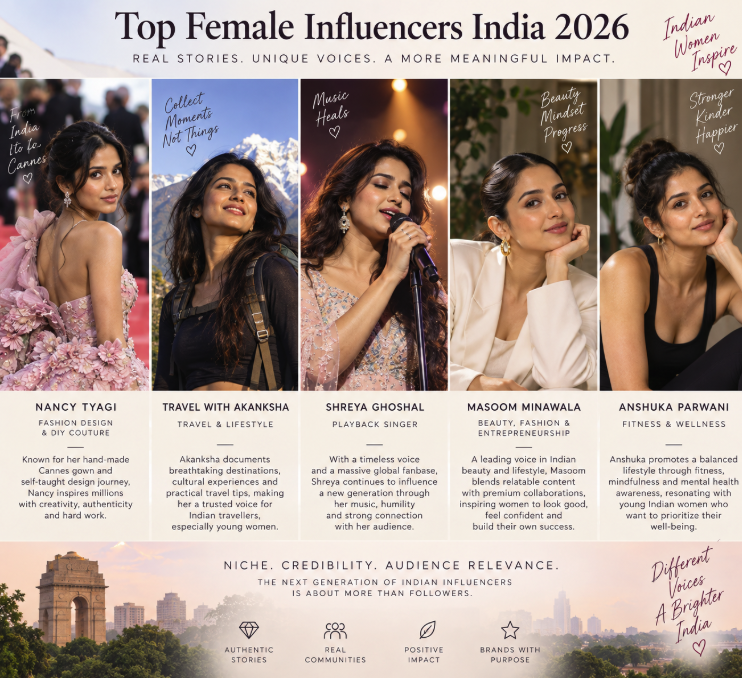
India's most interesting female influencers in 2026 are increasingly difficult to rank with a single number. A creator with millions of followers may deliver extraordinary mass reach, but a smaller specialist can offer deeper trust, clearer expertise and an audience that is far more relevant to a particular brand. Fashion, travel, beauty, music and lifestyle now operate as distinct creator ecosystems rather than one giant popularity contest.
A recent DHE Studio overview of female influencers in India captures that diversity particularly well. Its examples range from self-taught designer Nancy Tyagi to founder-creator Kamiya Jani and playback singer Neha Bhasin. The common thread is not content format or follower scale. It is a recognisable reason for the audience to care.
Nancy Tyagi turned making clothes into the content itself
Nancy Tyagi remains one of the clearest examples of why a creator's story can be more valuable than polished styling alone. The self-taught designer from Barnawa, Uttar Pradesh, built an audience by showing herself designing and stitching clothes rather than simply wearing finished looks. Her international breakthrough came at the Cannes Film Festival in 2024, where her self-made pink gown attracted widespread attention, and she returned to Cannes in 2025.
That distinction matters. Tyagi is not only a fashion influencer; craftsmanship is the entertainment. The process—choosing material, cutting, sewing and turning an idea into a finished outfit—creates credibility that a conventional sponsored fashion post cannot automatically reproduce. For textile, sewing, craft and fashion brands, her niche is unusually clear.
Kamiya Jani shows the power of building a media brand
Kamiya Jani represents a different model of influence. After working in business journalism, she founded Curly Tales and built it into a substantial travel-and-food media brand. Her personal profile is therefore only one layer of her reach. Curly Tales, its video formats and its celebrity-led “Sunday Brunch” franchise form a wider content ecosystem.
For travel, hospitality and food companies, that structure can be more useful than a conventional influencer account. The creator brings a recognisable personality, while the media brand provides established formats and distribution. Jani's National Creators Award recognition in the travel category in 2024 also reinforced her positioning within that niche.
Neha Bhasin is a performer first and an influencer second
Neha Bhasin demonstrates why the word “influencer” can sometimes be too narrow. Her career stretches back to the pop group Viva and includes playback singing across Hindi, Tamil and Telugu cinema, awards, nominations, reality television and live performance. Her social following grows around an established entertainment career rather than replacing one.
That changes what she can offer a campaign. A singer can provide live performance, music-led event value and cultural recognition that a social-first creator may not. For brands and organisers, the question is not simply how many people follow her account but whether they need a content creator, a public personality, a performer—or someone who can combine all three.
Komal Pandey made styling itself a signature format
Komal Pandey has built her position through a highly recognisable visual language. Her fashion content is theatrical, tightly styled and more experimental than the conventional outfit-of-the-day format. That distinctive aesthetic gives brands something valuable: viewers can often recognise the creator's approach before they have finished reading the caption.
Her relevance also illustrates why creator-brand alignment matters. A fashion label looking for bold transformation and high-concept styling may find her particularly suitable, while another brand seeking deliberately understated everyday content might choose differently. A large audience does not make every creator right for every brief.
Masoom Minawala connects creator culture with luxury business
Masoom Minawala Mehta occupies another useful category: the creator-entrepreneur with long-term luxury credibility. She moved from early fashion blogging into global fashion-week visibility, brand partnerships, entrepreneurship and investment, while also supporting women-led businesses through her Empowher initiative.
For premium brands, longevity matters. Luxury marketing depends heavily on context, and audiences notice when an expensive product appears suddenly on a feed with no relationship to the creator's normal world. Minawala's years of participation in fashion-week and luxury environments make that positioning more coherent.
Krittika Khurana and the value of an audience that grows with you
Krittika Khurana, widely known as That Boho Girl, is part of a generation that established itself before today's short-form creator boom. Her content has moved through fashion, styling, DIY, YouTube and travel, giving her audience years of familiarity with her voice.
That longevity can become a commercial asset. An audience that has watched a creator evolve may respond differently from one assembled around a single viral moment. Trust cannot be measured perfectly by account age, but consistent relevance across multiple platform eras is increasingly meaningful in an industry where attention can disappear quickly.
India's influencer market is moving beyond follower counts
This shift is not merely an editorial theory. ETBrandEquity reported in July 2026 that brands are moving beyond follower numbers toward audience relevance, narrative alignment and measurable business outcomes. The publication also highlighted the commercial importance of niche creators from tier-two and tier-three cities.
Exchange4media has described a similar change, with marketers prioritising audience trust, niche authority and category alignment over vanity metrics. Meanwhile, Kofluence's 2025-26 research portrays an increasingly structured creator industry in which brands are connecting influencer activity more directly to revenue targets and creators themselves are professionalising their operations.
Credibility is becoming measurable business value
Follower count remains useful because reach is real. A campaign that genuinely needs national-scale awareness may benefit from a mega-creator. The mistake is treating reach as a complete measure of influence. A million followers outside a brand's target market may be less commercially useful than 100,000 highly relevant viewers.
Marketers are consequently paying closer attention to audience geography, engagement quality, category expertise, content consistency and previous collaborations. A creator's followers should resemble the people the campaign actually needs to reach. This sounds obvious, but influencer marketing spent years rewarding visible scale because it was easier to measure.
Authenticity is also changing how fashion content looks
Vogue's September 2026 conversation with Meta fashion partnerships executive Eva Chen points to another change: fashion brands are leaning toward community, personality, behind-the-scenes material and more immediate content rather than obsessing over perfectly polished grids. Reels remain central, but the strategy increasingly rewards connection over immaculate production.
Nancy Tyagi's success fits this environment particularly well. The making of a garment can be more compelling than a conventional campaign photograph because viewers understand the labour and personality behind the finished piece. Process becomes proof of expertise.
How brands should choose a female creator in 2026
The first question should be what the campaign needs to achieve. Nancy Tyagi makes sense when craftsmanship and fashion construction matter. Kamiya Jani offers travel, hospitality and food context through both a personal identity and a media brand. Neha Bhasin brings entertainment and performance. Komal Pandey offers high-concept styling, while Masoom Minawala carries luxury-fashion and entrepreneurial positioning.
Only after defining that objective does follower count become useful. Brands should examine where the audience lives, whether comments suggest genuine engagement, how frequently the creator publishes sponsored material and whether previous partnerships feel credible. They should also clarify deliverables, usage rights, exclusivity and campaign measurement before content is produced.
The best Indian influencers are becoming harder to copy
The creator economy once encouraged imitation: find a successful format, reproduce it and accumulate as much reach as possible. In 2026, the stronger strategy is differentiation. A self-taught designer who can construct couture, a journalist who built a travel media company and a playback singer with a live-performance career are valuable precisely because their authority cannot be manufactured overnight.
That is why “top female influencer” is becoming a more interesting label in India. It no longer has to mean the woman with the biggest Instagram account. The creators with the strongest future may be those with the clearest answer to three questions: What is their niche, why should the audience trust them, and why is that audience relevant? In an increasingly professional creator economy, those answers can matter considerably more than another zero on a follower counter.