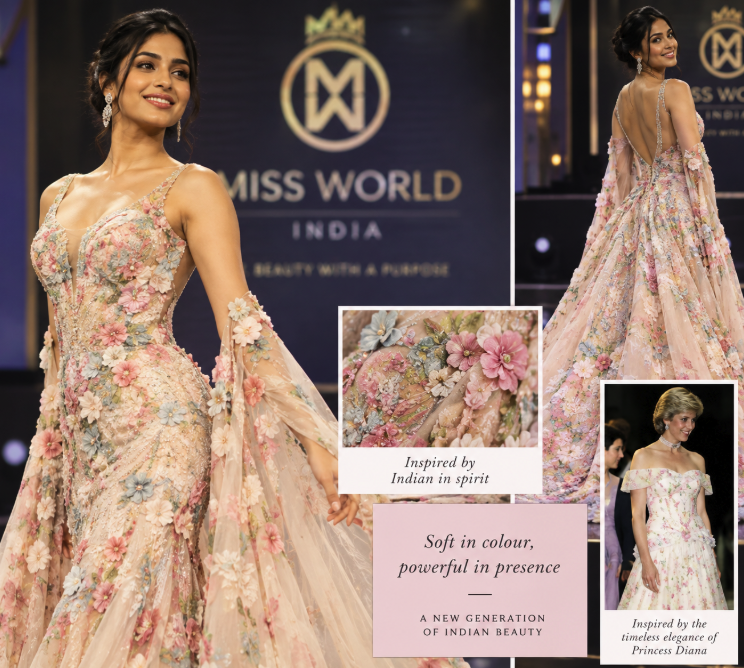
Nikita Porwal did not leave Miss World 2026 with the crown, but one of the clearest fashion stories from India's campaign arrived in blush pink. The Femina Miss India World 2024 winner reached the Top 40 at the September 5 finale in Nha Trang, Vietnam, wearing an intricately worked floral gown by designer Bhawna Rao. With a sculpted bodice, cascading flowers, hand embellishment and layers of lightweight tulle, the dress delivered the kind of softness that still reads strongly from a pageant stage.
The phrase attached to the look has proved almost as memorable as the gown itself: “soft in colour, powerful in presence, Indian in spirit.” It captures a wider fashion mood that is useful far beyond pageantry. Pastels no longer need to mean timid styling, and Indian identity does not have to be expressed only through an obviously traditional silhouette. Porwal's finale look used international eveningwear codes while allowing embroidery, handwork and detail to carry the Indian story.
The floral gown that accompanied India's Top 40 finish
Porwal's grand-finale gown was designed by Bhawna Rao in a pale blush palette. According to details shared by the Miss India organisation and reported by The Indian Express, the sculpted corset was covered with floral embroidery and hand embellishment, with thousands of beads and floral details creating a luminous surface. Sheer embellished sleeves softened the structure of the bodice.
Below the corset, the gown moved into a dramatic mermaid silhouette before opening into layers of Italian tulle. That combination is central to why the look photographed effectively: the fitted structure gives definition from a distance, while the tulle creates movement. Instead of relying on one oversized statement element, the dress builds impact through texture.
“Indian in spirit” without becoming costume
The most interesting part of the design is what it does not do. It does not require a sari drape, lehenga silhouette or instantly recognisable traditional motif to establish an Indian point of view. The cultural connection sits in the emphasis on embroidery, meticulous hand embellishment and craftsmanship.
That makes the gown relevant to a generation of Indian fashion consumers who move easily between Indian and Western wardrobes. A contemporary evening gown can still feel connected to Indian aesthetics when its surface work, colour sensibility or artisanal construction reflects local design traditions. Cultural identity becomes a design language rather than a dress code.
The Princess Diana gown was a different look
There is one important distinction in the coverage surrounding Porwal's Miss World wardrobe. The floral Bhawna Rao finale gown was not the Princess Diana-inspired dress. Before the finale, Porwal wore a separate gown by Saisha Shinde that drew inspiration from Princess Diana's famous sapphire engagement ring.
Shinde's Couture Fall 2026 collection used the royal jewel as an inspiration, and a gown from that collection was custom-made for Porwal. The reference was therefore more specific than simply copying one of Diana's dresses: it translated the visual identity and royal nostalgia of the sapphire ring into couture. Porwal's wardrobe effectively produced two different fashion stories—one built around royal inspiration and another around floral Indian craftsmanship.
Why Princess Diana remains a fashion reference in 2026
Diana's influence survives because designers can borrow from her image without reproducing an outfit literally. Her wardrobe moved between romantic gowns, formal royal dressing, sharp tailoring and increasingly confident fashion choices, giving contemporary designers several different versions of Diana to reference.
For younger Indian shoppers, the attraction is amplified by social media. Archive photographs that once belonged primarily to magazines and documentaries circulate constantly through fashion accounts, mood boards and short-form videos. A sapphire, neckline or pastel evening dress can trigger Diana associations for an audience born years after her death.
Soft colour is becoming a form of visual confidence
Porwal's finale gown offers an alternative to the idea that a major fashion moment needs saturated colour, metallic fabric or a very dark palette. Blush works precisely because the construction underneath it is assertive. The corseted shape, mermaid line and dense embellishment prevent the colour from disappearing under stage lighting.
This is the practical lesson behind “soft in colour, powerful in presence.” A pale palette can support strong design rather than replace it. Powder pink, champagne, muted peach, dusty rose and other delicate shades become more interesting when paired with architectural tailoring, three-dimensional florals, crystal work or a confident silhouette.
Florals are moving beyond the predictable print
The other element likely to travel into occasionwear is the use of dimensional flowers. Porwal's gown did not treat florals as a flat printed pattern. Embroidered and embellished blooms appeared to spread organically across the dress, turning the surface into part of the architecture.
That approach can translate particularly well into Indian wedding and evening fashion, where hand embroidery is already central. Expect the idea to appear in engagement gowns, reception dresses and contemporary lehengas through appliqué petals, tonal beadwork and botanical embroidery. The most modern versions will likely keep the palette restrained so that texture, rather than colour overload, creates the drama.
Nikita Porwal's Miss World result
Porwal represented India at the 2026 competition in Vietnam and advanced to the Top 40, but she did not make the Top 20. The crown ultimately went to Joheirry Mola of the Dominican Republic. In a message after the competition, Porwal reflected on a journey that did not end with the title but had allowed her to represent India internationally.
Her official Miss World profile also makes clear why her public image extends beyond fashion. The Ujjain-born actor, model, playwright and theatre creative director has performed in more than 60 theatrical productions and has spoken about work involving tribal communities, education, healthcare and sustainable livelihoods.
A pageant wardrobe with two very different kinds of nostalgia
Seen together, Porwal's two headline-making gowns explain why her Miss World fashion attracted attention. Saisha Shinde used one of the most recognisable objects associated with Princess Diana as a couture reference, connecting the wardrobe to global royal nostalgia. Bhawna Rao then moved in another direction for the finale, using blush florals and Indian handcraft to create a softer form of national representation.
That combination feels particularly current for Indian fashion in 2026. Inspiration can be international without losing cultural specificity, while Indian craftsmanship can appear in a thoroughly global silhouette. Porwal may have finished her Miss World journey at the Top 40, but her strongest fashion message is likely to travel further: softness does not have to disappear into the background. With the right construction, detail and confidence, it can command the entire room.