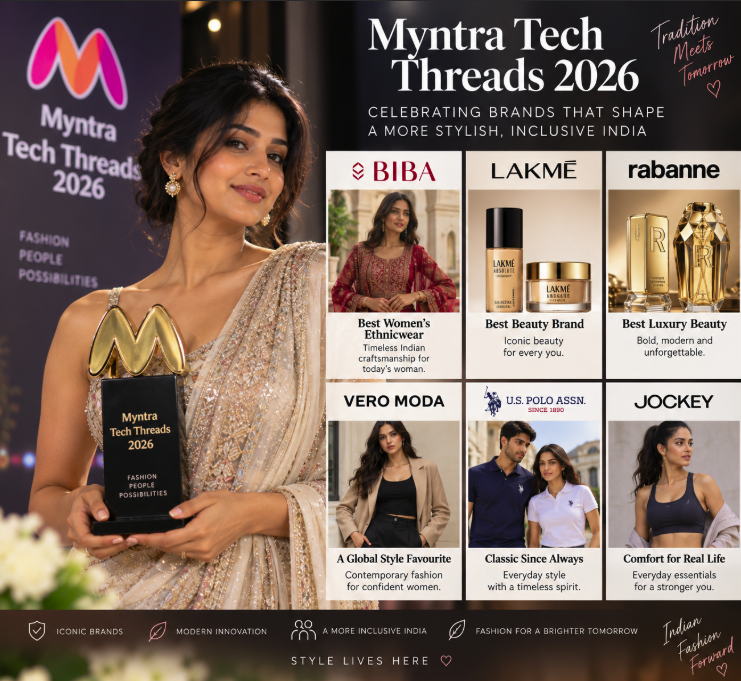
India's fashion market is becoming harder to describe with old divisions such as “traditional” and “Western.” At Myntra Tech Threads 2026, the brands receiving recognition stretched from Biba's ethnicwear to Lakmé beauty, Rabanne luxury cosmetics, global fashion names and everyday essentials. Together, the winners offer a useful snapshot of what Indian shoppers increasingly expect: cultural familiarity, contemporary design, convenience, performance and a strong digital retail experience.
Myntra's flagship brand conclave returned under the theme “Where Velocity Meets Voice,” bringing fashion and lifestyle leaders together to discuss technology, consumer behaviour, product discovery and brand growth. The accompanying awards recognised companies across fashion, beauty, footwear, jewellery, sports, travel gear, watches and home. It was less a single fashion ranking than a map of the categories competing for India's attention in 2026.
Biba wins Best Women's Ethnicwear Brand
Biba was recognised as Best Women's Ethnicwear Brand, a result that neatly reflects one of the most important forces in Indian women's fashion: traditional references becoming easier to wear in contemporary life. Myntra's own current Biba assortment spans kurta sets, kurtas, dresses, lehengas, trousers, tops and accessories, illustrating how broad the modern “ethnicwear” category has become.
The brand's strength is not simply preserving familiar Indian silhouettes. It is making them compatible with changing wardrobes. A kurta can be styled with jeans, a printed top can enter a work wardrobe, and coordinated sets can move between everyday dressing and celebrations. That flexibility is increasingly important for women who do not separate their closets into rigid Indian and Western sections.
Lakmé takes Best Beauty Brand
Lakmé received the Best Beauty Brand award, with Myntra's Tech Threads coverage highlighting the brand's role in shaping how consumers discover and experience beauty. For a long-established Indian name, the recognition also demonstrates that heritage does not automatically mean nostalgia.
Beauty shopping has become one of India's most digitally dynamic categories, driven by new product launches, tutorials, creator recommendations and increasingly informed ingredient conversations. Legacy brands now compete in the same feed as younger D2C labels and global prestige names. Staying relevant means combining familiarity with constant product and marketing evolution.
Rabanne wins Best Luxury Beauty Brand
Rabanne was named Best Luxury Beauty Brand, placing premium international beauty firmly inside the Tech Threads picture. Luxury fragrance and cosmetics are increasingly part of a broader Indian lifestyle market in which consumers mix domestic favourites with global labels rather than choosing exclusively between the two.
The award also shows how beauty is expanding beyond utility. Fragrance, packaging, fashion-house heritage and the experience of owning a prestige product all influence purchase decisions. In that environment, luxury beauty competes as much on identity and aspiration as it does on product performance.
Vero Moda, USPA and Jockey show the breadth of everyday fashion
Vero Moda, U.S. Polo Assn. and Jockey were among the fashion brands recognised across the awards' apparel categories, alongside Biba, Underneat and NEXT. Myntra's published overview does not list the precise individual award title for each of these names, but their inclusion illustrates how wide the Indian fashion basket has become.
Vero Moda represents contemporary international womenswear, U.S. Polo Assn. sits within globally recognisable casual lifestyle dressing, and Jockey is rooted in comfort-led essentials. These are very different propositions, yet a single customer can realistically buy from all three. Modern retail loyalty increasingly belongs to categories and occasions rather than one brand controlling the entire wardrobe.
The Pant Project, Comet and Powerlook represent the newer generation
The awards were not dominated by established companies. The Pant Project won Best D2C Brand, Comet was named Disruptor Brand of the Year and Powerlook received Gen Z Brand of the Year. Their presence matters because digital-first and younger labels are forcing larger companies to compete on speed, specificity and cultural relevance.
D2C brands often begin with a narrower problem than traditional fashion houses. That focus can help them build an identifiable community before expanding. Myntra's recognition of these companies suggests that marketplace scale and specialist brand identity are no longer opposing strategies; successful emerging labels increasingly need both.
H&M and Mango underline India's appetite for global fashion
H&M was named Velocity Brand of the Year, while Mango received Best International Brand. The awards highlight the continuing importance of international fashion to Indian consumers even as homegrown brands expand rapidly.
The more interesting trend is how global and Indian aesthetics coexist. A shopper might wear Mango tailoring with Indian jewellery, an H&M shirt over an ethnic skirt or a Biba kurta with contemporary footwear. “Fusion” no longer needs to be announced as a special fashion category. For many consumers, mixing references is simply how getting dressed works.
Indian tradition is becoming a contemporary product language
Biba's win is especially useful for understanding the event's broader message. Indian tradition remains commercially powerful, but the brands most capable of extending it into everyday wardrobes are translating it rather than freezing it. Prints, embroidery, colour and familiar silhouettes can be adapted to lighter fabrics, cleaner cuts and easier styling.
This approach also gives homegrown companies an advantage that international labels cannot manufacture instantly: cultural fluency. The challenge is to use that fluency without becoming repetitive. Younger shoppers may appreciate Indian craft and identity while still expecting modern fit, digital convenience and styling that works beyond festivals.
Accessories and lifestyle categories are part of the fashion conversation
Tech Threads 2026 extended far beyond clothing. Zouk won Best Handbags Brand, Mokobara was recognised as Best Travel Gear & Accessories Brand, Palmonas took Best Jewellery Brand and Plum won Best Personal Care Brand. Timex was named Best Watches Brand, while D'Decor received Best Home & Living Brand.
That breadth reflects how fashion marketplaces have evolved into lifestyle platforms. A shopper discovering a dress may also be looking for jewellery, luggage, skincare or home products. The commercial opportunity is no longer only to sell an outfit; it is to remain relevant across multiple expressions of personal taste.
Performance and comfort have become style categories too
Decathlon was named Best Sports Apparel Brand and New Balance received Best Sports Footwear Brand. Hush Puppies and CAI were recognised in men's casual footwear and women's footwear respectively. These wins reinforce the continued collapse of the boundary between functional products and fashion.
Indian consumers increasingly expect sportswear to look good outside the gym, travel products to be aesthetically considered and comfortable footwear to fit a broader wardrobe. Performance is no longer an excuse for generic design. At the same time, fashion that ignores comfort has a harder time competing for everyday use.
Technology sits behind the awards even when the product looks traditional
The “Tech” in Tech Threads is important. Myntra framed the 2026 conclave around how technology influences consumer discovery, changing behaviour and brand scaling. A hand-embroidered kurta may look culturally traditional, but the way a shopper finds it can involve recommendation systems, search, social content, reviews, digital payments and highly optimised logistics.
This is one of the defining contradictions of Indian fashion in 2026: some of the products with the strongest heritage identity are being sold through extremely modern infrastructure. Brands that understand both sides can preserve a distinctive point of view while reaching consumers at marketplace speed.
The winners reveal a wardrobe without rigid boundaries
There is no single aesthetic connecting Biba, Lakmé, Rabanne, Vero Moda, U.S. Polo Assn. and Jockey. That is precisely why the Tech Threads winners are interesting. They represent different parts of the same consumer's life: ethnic occasions, makeup, prestige beauty, contemporary fashion, casual dressing and everyday comfort.
The bigger 2026 trend is therefore not that Indian shoppers are choosing tradition over modernity, or global brands over homegrown ones. They are combining them. The brands that thrive are those able to occupy a clear role in that mixed wardrobe while remaining easy to discover and relevant to changing lifestyles. Myntra Tech Threads 2026 makes the direction visible: Indian fashion is moving forward not by abandoning its traditions, but by giving consumers more contemporary ways to wear, mix and shop them.