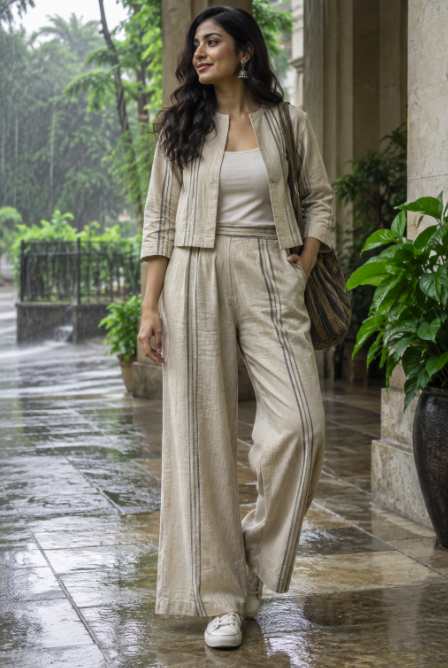
India’s monsoon wardrobe is getting a distinctly handcrafted update in 2026. Khadi and other handloom fabrics, once strongly associated with saris, kurtas, ceremonial dressing and heritage wardrobes, are increasingly appearing in contemporary jackets, co-ord sets, dresses, trousers and shirts. The appeal is not simply nostalgia. Designers are translating traditional textile techniques into relaxed silhouettes that fit the way younger consumers work, travel and dress every day.
The shift has become especially visible during the rainy season. A September 10 report by Bombay Samachar describes handloom as a notable monsoon fashion story, pointing to demand for cotton, linen, khadi and regional handwoven textiles in modern cuts. The publication highlights a combination that is becoming central to the trend: cultural identity on one side and practical, contemporary dressing on the other.
Why handloom feels current again
Handloom’s return is part of a broader rethink of what traditional Indian fabric can look like. Instead of treating craft textiles as something reserved for formal occasions, labels are using them as raw material for everyday fashion. The result can be a cropped jacket worn with wide-leg trousers, an easy shirt over denim, a loose dress for humid weather or a matching co-ord that works equally well for an office, café or weekend trip.
Recent collections reinforce that direction. In August, Indulge Express reported on Terra Luna’s monsoon khadi edit, which uses organic khadi cotton across dresses, co-ords, trousers and shirts. Founder Stuti Dhanuka described the approach as lighter and more fluid, with softer tailoring and even athleisure-influenced ideas. That vocabulary matters because it moves khadi away from a fixed visual stereotype and places it inside the same styling conversation as other contemporary wardrobe fabrics.
The New Indian Express has documented a similar transformation across Indian handloom more broadly. Designers working with Chendamangalam textiles, kasavu, Kala cotton and other regional traditions are experimenting with modern garments, embroidery, appliqué and new combinations of patterns and techniques. The common thread is not abandoning heritage but changing its context: the textile remains recognisable while the garment becomes easier to integrate into a younger wardrobe.
The monsoon advantage is comfort, not waterproofing
There is a practical reason natural handwoven fabrics attract attention during humid weather. Lightweight cotton and linen-based garments can feel more breathable and comfortable than many heavy or clingy alternatives. That does not mean every handloom textile is automatically ideal for heavy rain, nor that khadi itself should be treated as rainwear. The useful distinction is between dressing for humid monsoon conditions and dressing to stand directly in a downpour.
For daily use, the strongest pieces are therefore often uncomplicated ones: relaxed shirts, airy trousers, dresses with room for movement and light jackets that can be layered when needed. Shorter hems can be more convenient on wet streets, while separates make it easier to adjust an outfit as temperatures and humidity change through the day. Footwear and drying time still matter, so the most practical monsoon interpretation of the trend is a breathable handloom wardrobe combined with weather-appropriate shoes and outer protection when rain becomes heavy.
Tradition plus modernity is the real look
The strongest styling idea for 2026 is contrast. A handwoven shirt does not need to be paired only with traditional bottoms; it can sit comfortably with straight jeans or tailored trousers. A khadi jacket can sharpen a plain tank and wide-leg pants. Handloom co-ords can be kept minimal with sneakers and a practical tote, while a simple dress can take on a more urban character with contemporary jewellery and a structured bag.
Colour is changing too. Khadi is no longer confined to the familiar image of unbleached cream or earthy neutrals. Contemporary collections are using blues, greens, coral tones, checks, stripes and handcrafted prints. This gives shoppers a way to retain the tactile irregularity and craft identity of the textile without making every outfit feel overtly traditional.
That evolution helps explain why handloom is resonating with younger buyers. A Times of India fashion feature in July identified several handloom fabrics returning to contemporary wardrobes, including Ikat in jackets, dresses and shirts and lighter interpretations of traditionally formal textiles. Hindustan Times likewise noted in August that Indian fashion increasingly mixes heritage references with co-ords, denim, sneakers and other modern wardrobe staples. Rather than choosing between Indian craft and global styling, consumers can combine both.
Craft, provenance and the sustainability question
Handloom also benefits from growing interest in knowing how and where clothes are made. A handwoven textile can carry a visible connection to a weaving region, technique or artisan community, giving the garment a story that mass-produced fabric often lacks. Open Magazine’s August examination of khadi’s evolution noted its growing relevance among younger Indians and design professionals, alongside its established historical significance.
Sustainability claims, however, deserve some care. Handloom production can rely less on mechanised weaving and khadi is associated with hand-spinning and hand-weaving, but a garment’s overall environmental impact also depends on fibres, dyes, finishing, transport, durability and how long it is actually worn. Consumers interested in the sustainability argument should therefore look beyond a simple “handmade” label and ask about fibre composition, production methods and provenance.
Authenticity is another important issue. Handloom and powerloom fabrics are not always easy for shoppers to distinguish, and designers interviewed by The New Indian Express have pointed to consumer confusion in this area. Buyers who specifically want authentic handwoven products can favour transparent labels, recognised craft organisations, established designers working directly with weaving communities and sellers willing to explain where and how a textile was produced.
A trend with room to last beyond the rains
Monsoon 2026 may be giving khadi and handloom an unusually visible fashion moment, but the more significant development is their move into ordinary wardrobes. Jackets, shirts, trousers, co-ords and dresses are formats people can wear repeatedly rather than save for a festival or formal event. That makes the revival less dependent on a single seasonal aesthetic.
The most convincing version of the trend is also the simplest: wear Indian craft without feeling obliged to build an entirely traditional outfit around it. A well-cut handloom piece can be the distinctive element in an otherwise modern look. For shoppers drawn to clothing that combines texture, cultural provenance and everyday versatility, khadi and handloom are no longer merely heritage choices. In 2026, they are increasingly becoming contemporary wardrobe choices in their own right.