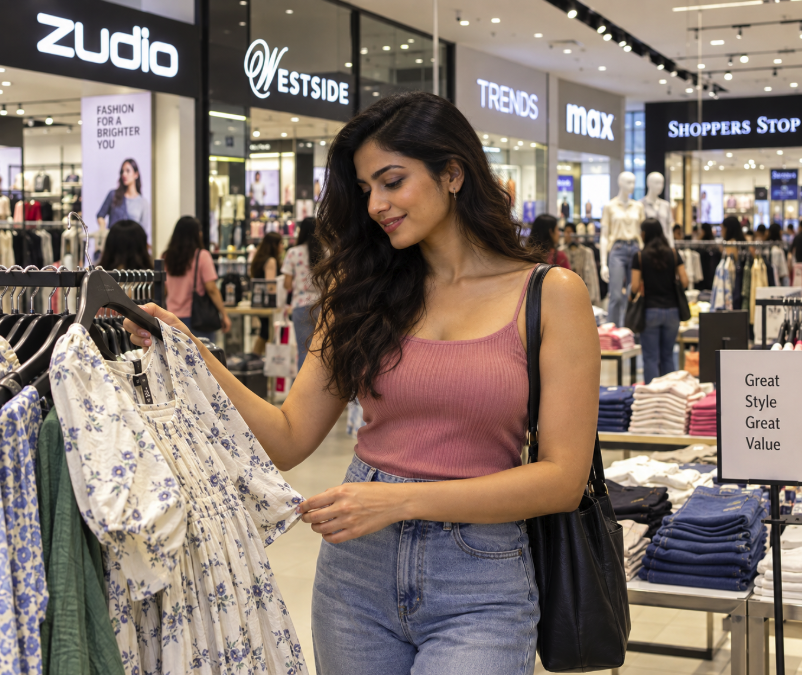
India’s organised apparel retailers are entering FY27 with a familiar consumer demand at the centre of the market: shoppers want fashion that looks current without stretching the household budget. That is strengthening value-fashion chains, accelerating organised retail’s expansion outside the largest metropolitan areas and giving branded clothing a larger role in cities where unorganised stores have historically dominated.
CRISIL Ratings said on September 10 that revenue for India’s organised apparel retail sector is expected to grow around 12–13% in FY27. The forecast is slightly below the roughly 15% growth recorded in the previous fiscal year, but the underlying picture remains healthy. CRISIL identifies value fashion, expansion beyond large cities and sustained demand for branded apparel as the main supports for growth.
Value fashion has moved to the centre of the market
The most important number in CRISIL’s analysis may be value fashion’s rising share of organised retail revenue. The agency says value fashion has grown more than twice as fast as other apparel segments over the past three fiscals, lifting its revenue share to 46% from 39%. Value/fast fashion and mid-premium merchandise, much of it priced below INR 2,500, now accounts for around two-thirds of sector revenue.
This helps explain why formats built around frequent newness and accessible prices are receiving so much attention. Zudio is the most obvious example. Parent company Trent reported a 19% year-on-year increase in standalone revenue to INR 5,666 crore for the first quarter of FY27. At June 30, 2026, its portfolio included 982 Zudio stores and 301 Westside stores, alongside other lifestyle concepts. During the quarter, Trent added 19 Zudio locations on a net basis compared with one Westside location.
The scale illustrates how value fashion has evolved from a secondary retail segment into a major battleground. Consumers who might previously have bought unbranded apparel in a local market can increasingly access organised stores offering fashionable designs, predictable sizing, air-conditioned shopping environments and rapid merchandise rotation at relatively low price points.
The next retail opportunity is increasingly outside the metros
Smaller cities are becoming crucial to that expansion. CRISIL says the increasing penetration of organised retailers into smaller cities is one of the reasons value fashion is gaining share. Expansion there can also require less capital than comparable growth in major urban centres, helping retailers widen their physical footprint without placing the same pressure on balance sheets.
India Ratings and Research reached a similar conclusion in its FY27 apparel outlook. It expects value retailers to outperform, supported by resilient demand in Tier-2 cities and beyond and by the continuing migration from unorganised to organised trade. Its sector revenue forecast is somewhat more conservative than CRISIL’s, at about 10.5% year-on-year growth for FY27, showing that estimates differ even though the direction of the market is broadly consistent.
CareEdge Ratings has also identified Tier-2 and Tier-3 cities as important consumption hubs. Data summarised by the India Brand Equity Foundation earlier in 2026 put organised retail at roughly 41% of India’s overall apparel market and projected organised apparel to expand faster than the broader market as consumers increasingly choose branded clothing and structured retail formats.
Zudio, Westside, Trends, Max Fashion and Shoppers Stop compete from different positions
For shoppers, the growth story is not about one single format. Zudio is positioned firmly around value and high merchandise turnover, while Westside occupies a broader lifestyle and private-label space. Reliance Trends and Max Fashion address mass-market families and fashion-conscious consumers through extensive physical networks, while Shoppers Stop operates a department-store model with a stronger mix of national and international brands.
That difference matters because “affordable fashion” is not one fixed price category. A shopper may visit Zudio for a low-cost trend piece, move to Max Fashion or Trends for everyday clothing, choose Westside for design-led private labels and use Shoppers Stop when looking for a wider branded assortment. Retailers are therefore competing not only on absolute price but on perceived value: how much style, quality, convenience and brand confidence a customer believes she receives for the money.
The market is also becoming more polarised. India Ratings expects value retail to outperform while premium/branded and ethnic formats grow at steadier high-single-digit rates. That suggests the strongest proposition is increasingly clear at either end: compelling value for price-conscious shoppers or enough brand, product and experience differentiation to justify paying more.
Festive season will be a major FY27 test
The timing of the current outlook is significant because the festive period has begun. CRISIL estimates that festive spending typically contributes nearly 35% of annual apparel sales. Between April and August 2026, sector revenue growth remained in the high single digits and was largely driven by value fashion, making festive demand particularly important if retailers are to reach the full-year growth forecast.
This period will test whether consumers continue prioritising apparel when other discretionary categories are competing for the same wallet. CRISIL says the expected FY27 growth slowdown from the previous year partly reflects consumers spreading discretionary spending beyond clothing. Retailers therefore need more than new stores: they need assortments that persuade shoppers to buy now rather than postpone a purchase.
Fast merchandise cycles, festive collections, entry-level price points and a mix of Western and Indian wear can all help. Branded retailers also have the advantage of loyalty programmes, digital marketing and customer data, which can make promotions more targeted than the traditional blanket discounting approach.
Growth does not mean an easy year for retailers
The revenue forecast comes with an important warning. CRISIL expects rising cotton prices and elevated operating costs to put pressure on profitability. With competition intense, retailers may be unable to pass all those increases to consumers. The ratings agency consequently expects operating margins to compress by around 100 basis points to approximately 14% this fiscal.
That creates a delicate equation for value-fashion businesses. Their appeal depends on maintaining prices that feel accessible, but stores, logistics, staff, sourcing and raw materials all cost more when inflation moves against them. Raising prices too aggressively risks weakening the very proposition that is generating growth; absorbing every increase can damage margins.
Scale can help, but so can inventory discipline. Fashion retail punishes companies that order too much of the wrong product because unsold merchandise eventually requires discounting. Retailers expanding rapidly into new cities also need to understand local demand rather than assume that assortments successful in Mumbai, Delhi or Bengaluru will perform identically everywhere else.
What the FY27 trend means for shoppers
For consumers, particularly younger women looking for frequent wardrobe updates, the expansion of organised value fashion means more choice outside traditional metropolitan shopping districts. The strongest chains are bringing branded environments and trend-responsive merchandise into a wider range of Indian cities, narrowing the difference between what shoppers can access in a major metro and what is available in a smaller urban market.
Price, however, should not be confused automatically with quality. An inexpensive garment can represent good value when its fabric, stitching and fit hold up through repeated use; a slightly more expensive item may be the better purchase if it lasts considerably longer. As competition increases, consumers can afford to compare construction, return policies, sizing consistency and actual cost per wear rather than relying on the brand name alone.
FY27 is therefore shaping up as another important stage in the formalisation of Indian fashion retail. CRISIL’s 12–13% growth forecast suggests organised apparel remains a strong consumer category even as spending becomes more selective. The bigger structural story is where that growth is coming from: value-led formats, branded apparel and stores reaching beyond the traditional metro map. Zudio, Westside, Trends, Max Fashion and Shoppers Stop represent different parts of that landscape, but all are competing for a consumer who increasingly expects fashion, accessibility and a credible retail experience at the same time.