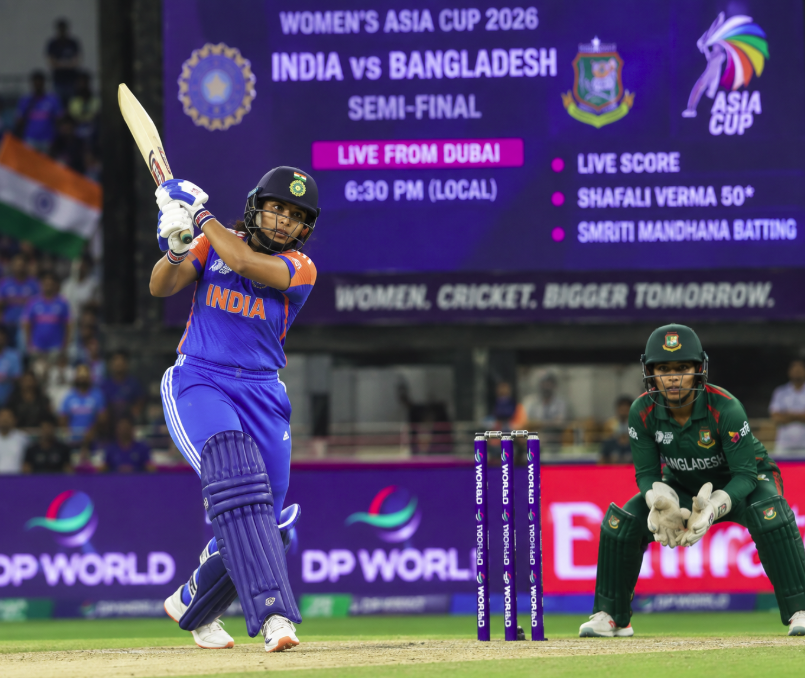
India Women are through to the Women’s Asia Cup 2026 final after defeating Bangladesh Women by 40 runs in Thursday’s first semi-final at the Dubai International Cricket Stadium. What began the evening as a live-search surge around Shafali Verma, Smriti Mandhana and the semi-final score ended with another commanding Indian result: 149 for six from 20 overs followed by a successful defence that held Bangladesh to 109 for seven.
Shafali was the central figure with the bat. The India opener scored 64 from 40 balls, giving the innings the momentum it needed on a surface where a total of 149 initially appeared defendable rather than overwhelming. Her half-century also continued an excellent individual tournament and moved her ahead of opening partner Mandhana as the competition’s leading run-scorer after the semi-final.
Shafali delivers when the knockout pressure arrives
Shafali entered the semi-final already in strong form. The ICC reported before the match that she had scored 104 runs in India’s first three Asia Cup games and had formed an effective opening combination with Mandhana. She had also produced a Player-of-the-Match half-century against Bangladesh during the 2026 Women’s T20 World Cup, making her one of the obvious players for Bangladesh to contain in Dubai.
They could not contain her for long enough. Shafali’s 64 provided the foundation for India’s 149 for six, and late contributions from captain Harmanpreet Kaur and Richa Ghosh helped India push the total upward in the closing overs. The final score was not enormous by modern T20 standards, but it proved comfortably beyond Bangladesh once India’s bowlers established control.
The innings also changed the tournament’s batting leaderboard. Jansatta reported after the match that Shafali had reached 168 runs from four innings, overtaking Mandhana, who stood at 154. The two Indian openers are the only batters to have passed 100 runs in the competition at this stage, underlining how heavily India’s batting momentum has been driven from the top.
Mandhana remains central to India’s tournament
Although the semi-final belonged primarily to Shafali, Mandhana remains one of the defining players of India’s Asia Cup campaign. Her tournament arrived immediately after a major career milestone: Reuters reported on September 4 that Mandhana had become the leading run-scorer in women’s international cricket, surpassing Mithali Raj’s previous record during India’s Asia Cup victory over Hong Kong China.
That innings against Hong Kong was extraordinary in its own right, with Mandhana making 124 from 64 balls. Her partnership with Shafali has subsequently given India a top order capable of changing a match rapidly. In a knockout game, Bangladesh therefore faced the difficult task of attacking early without offering either opener enough loose deliveries to establish control.
The semi-final reinforced the value of having two in-form openers rather than relying on one star. Even when Mandhana does not produce the defining innings, Shafali can assume the attacking role. That flexibility becomes especially valuable in a tournament final, where one early wicket can otherwise change the entire tempo of a T20 innings.
Deepti Sharma closes the door on Bangladesh
India’s bowlers ensured Shafali’s work was not wasted. Bangladesh were restricted to 109 for seven, leaving them 40 runs short of the target. Deepti Sharma led the attack with three wickets, applying pressure through the chase and preventing Bangladesh from building the partnerships required to threaten India’s total.
According to post-match tournament statistics reported by Jansatta, Deepti has now taken 11 wickets from four matches, making her the leading wicket-taker in the competition. Shree Charani is also among the tournament’s leading bowlers with eight wickets. That balance between an explosive opening pair and a wicket-taking bowling unit helps explain why India have reached the final without losing a match.
Bangladesh had arrived in the knockout stage after finishing second in Group B behind Sri Lanka. They had beaten Indonesia and the United Arab Emirates but lost to Sri Lanka, while India topped Group A with victories over Thailand, Hong Kong China and Pakistan. India therefore entered the semi-final as favourites, but Bangladesh’s bowling resources and previous experience of upsetting stronger opponents meant the contest still carried genuine knockout risk.
India’s unbeaten run reaches the final
India’s path through the tournament has been emphatic. They won all three group matches before Thursday’s semi-final and have now added Bangladesh to the list. The 40-run victory sends them into another Women’s Asia Cup final and keeps alive their attempt to reclaim the title after Sri Lanka defeated them in the 2024 final.
Pre-match coverage had focused heavily on whether India’s middle order would deliver if the openers were unable to dominate. Shafali herself expressed confidence in the batting group before the semi-final, telling the ICC that the players were capable of responding when needed. Against Bangladesh, India again benefited from a major contribution at the top, but Harmanpreet and Richa’s late acceleration offered a useful sign that the innings did not depend exclusively on the opening partnership.
The final opponent will emerge from the second semi-final between Sri Lanka Women and Pakistan Women, scheduled in Dubai on September 11. The final itself is scheduled for September 13. Either matchup would carry a compelling storyline: Pakistan would produce another high-profile India-Pakistan contest, while Sri Lanka would create a rematch of the 2024 final.
From live-score trend to decisive result
Interest around the match surged while Shafali was building her half-century and Mandhana was at the crease, with fans searching for live scores and batting updates from the 6:30 PM local start in Dubai. By the end of the night, however, the story had moved beyond a live-score update. India had posted 149 for six, Shafali had made 64, Deepti had taken three wickets and Bangladesh had finished on 109 for seven.
Those numbers capture the result, but the larger message is India’s consistency. Mandhana entered the tournament in record-breaking form, Shafali has now overtaken her on the Asia Cup run chart, and Deepti leads the bowling standings. When different parts of a team are producing tournament-leading performances simultaneously, knockout cricket becomes considerably easier to control.
India now have one match left to convert that form into the title. Thursday’s semi-final did not require an enormous total or a last-over escape. It required one opener to seize the innings, the middle order to add enough at the finish and the bowlers to make 149 feel much larger than it first appeared. India executed all three parts and, as a result, will play for the Women’s Asia Cup trophy on September 13.