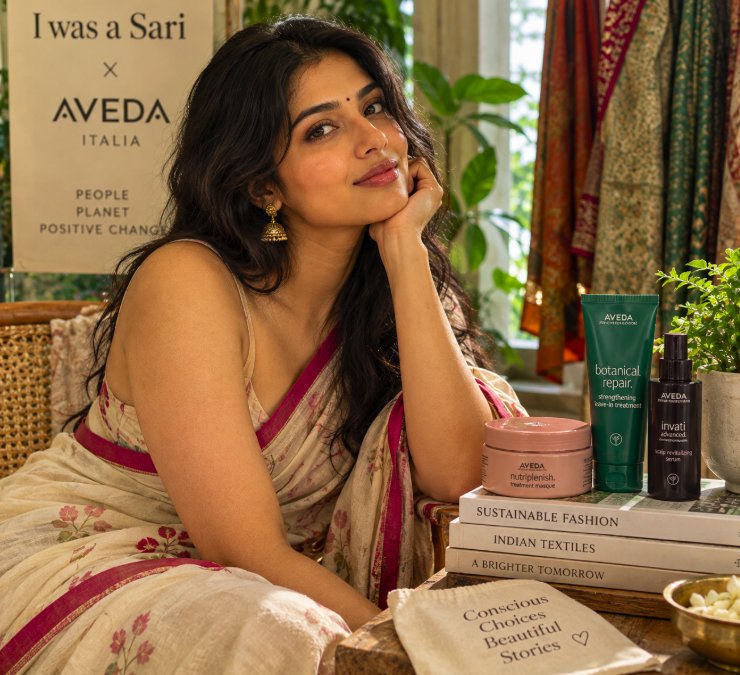
Indian ethical-fashion label I Was a Sari is entering a new Italian beauty conversation through a collaboration with Aveda Italia, bringing together two categories that increasingly speak the same language: personal care and conscious consumption. The partnership accompanies Aveda's new One For All Leave-In Elixir in Italy and puts the spotlight on a Mumbai-rooted fashion project that transforms pre-loved saris into contemporary clothing and accessories while creating employment and training opportunities for women artisans.
The collaboration is timely. Beauty and fashion consumers are becoming more interested in what sits behind a product: where materials come from, who makes it and whether sustainability claims extend beyond packaging. I Was a Sari has built its identity around precisely those questions, using existing textiles rather than virgin fabric and positioning craftsmanship and women's economic independence at the centre of the brand.
From Mumbai sari markets to contemporary fashion
I Was a Sari emerged from an idea developed between Italy and India. Founder Stefano Funari encountered piles of second-hand saris in Mumbai and saw an opportunity to transform material that already existed into something contemporary. The project developed with design input connected to Politecnico di Milano and production rooted in Mumbai, where women artisans learned tailoring and embroidery skills.
The concept is straightforward but visually powerful: a sari that has completed one life becomes the raw material for another. Prints, borders and colour combinations that might otherwise disappear are redesigned as dresses, bags, jewellery and accessories. Because the source textiles are pre-loved, individual pieces can carry variations that are difficult to reproduce through conventional mass manufacturing.
Why the Aveda Italia collaboration makes sense
Vanity Fair Italia reported the collaboration in September 2026 alongside Aveda's launch of One For All Leave-In Elixir, a leave-in hair product presented as offering 25 benefits and formulated with 99% naturally derived ingredients. The publication described I Was a Sari as the Indian ethical-fashion brand distributed in Italy by Oxfam Italia and highlighted its work turning discarded traditional saris into new accessories.
The connection is not simply aesthetic. Aveda has long positioned environmental responsibility as part of its brand identity, while I Was a Sari's proposition is built around circular design and social impact. Bringing beauty and upcycled fashion together gives the Italian launch a wider lifestyle narrative: hair care on one side, textile reuse and Indian craftsmanship on the other.
I Was a Sari is about people as much as fabric
The social element is essential to understanding why the label has attracted international attention. Oxfam Italia describes the project as both circular fashion and a pathway toward women's empowerment, reporting that more than 650 artisans have received opportunities through the initiative. The organisation distributes I Was a Sari in Italy through its fair-trade channels.
The brand's own current sustainability reporting goes further. I Was a Sari says an independently assessed 2025 survey of 126 jobholders found a 1,124% increase in average daily income, with 99% reporting that they had learned a new skill on the job. Those figures are unusually specific for a fashion brand and reflect an effort to make social-impact claims measurable rather than relying only on broad language about empowerment.
Upcycling is becoming a design advantage
Sustainable fashion has sometimes struggled with the perception that responsibility requires sacrificing style. I Was a Sari takes the opposite approach: the existing textile is the design opportunity. Vintage patterns, embroidery and colour combinations give designers material that would be expensive and resource-intensive to reproduce from scratch.
The model has already attracted recognition well beyond a niche ethical-fashion audience. Vogue has covered the label's circular approach and its work with women artisans, while SDA Bocconi has examined I Was a Sari as a business case in competitive and sustainable upcycling. The project has also previously worked with Gucci-related initiatives to develop embroidery skills among artisans.
Why younger Indian shoppers may pay attention
For younger Indian consumers, sustainability increasingly competes with several other purchase considerations: design, price, authenticity, social visibility and cultural relevance. I Was a Sari has an advantage because its sustainability story is visibly connected to Indian material culture rather than added to an otherwise conventional product. The sari is immediately recognisable, yet the final object can belong to a contemporary wardrobe.
That combination can resonate with shoppers who want Indian identity without necessarily wanting traditional styling every day. Upcycled pieces offer a way to keep familiar textiles in circulation while changing their function and silhouette. They also fit a broader interest in products with a traceable story—particularly when social media has made behind-the-scenes production part of how fashion is discovered and evaluated.
Italy is an important part of the brand's story
The Aveda Italia connection also brings the project back toward one of its creative origins. The concept behind I Was a Sari was developed with links to Milanese design thinking before becoming a Mumbai-based enterprise. Oxfam Italia later became an important distribution partner, giving the label an established route into the Italian ethical-consumption market.
That India-Italy relationship makes this collaboration more interesting than a conventional promotional tie-in. Italian design institutions and distribution helped shape the project's international development, while the actual materials, craftsmanship and social mission remain firmly connected to India. It is a two-way exchange rather than an attempt to make Indian craft appear European.
Conscious beauty and ethical fashion are converging
Beauty brands increasingly talk about refill systems, ingredient sourcing, packaging waste and responsible supply chains. Fashion companies discuss many of the same issues through textiles, labour and circularity. Consumers therefore encounter sustainability less as a separate category and more as an expectation that can follow them from shampoo to clothing.
Collaborations such as I Was a Sari x Aveda Italia make that convergence visible. They can also invite greater scrutiny, which is healthy: consumers should be able to distinguish measurable environmental or social work from vague green marketing. I Was a Sari's public impact reporting and long-standing artisan model give the partnership a more concrete story to tell.
A sari's second life becomes part of a larger trend
The most compelling aspect of I Was a Sari remains remarkably simple. Instead of beginning with new fabric, the brand begins with something that already exists and asks what it can become next. That principle reduces the need for virgin material while turning the irregularities of pre-loved textiles into part of the design.
With Aveda Italia bringing the label into a beauty-focused launch, the audience for that idea expands beyond sustainable-fashion specialists. For Indian shoppers following global trends and Italian consumers discovering Indian circular design, the collaboration connects beauty, craftsmanship and responsible consumption in a way that feels increasingly relevant. The sari may be the starting material, but the bigger story is about how fashion can create value without always starting from zero.