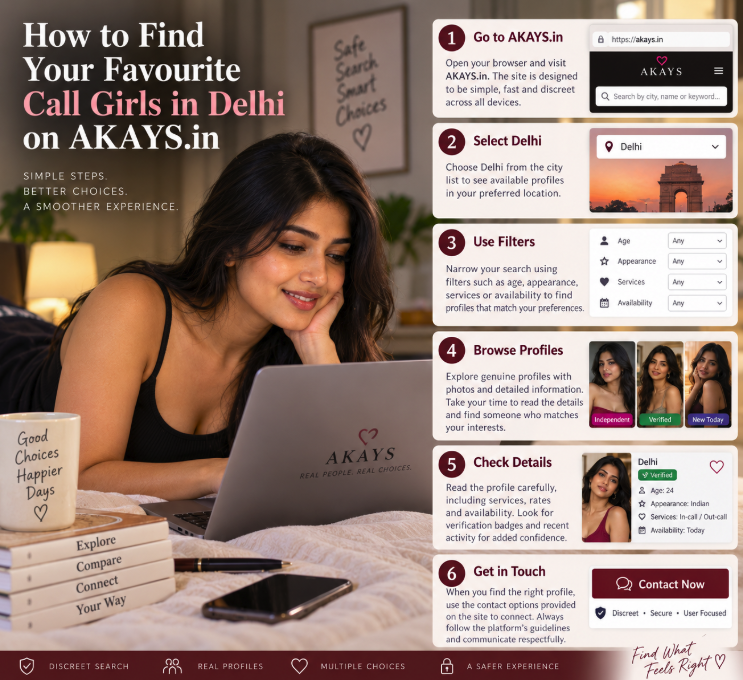
Searching a large city directory can become confusing quickly, especially in Delhi, where location labels, profile styles and advertiser descriptions can vary considerably. Akays.in operates as a directory that organises independent companion listings across Indian cities, so the useful skill is not clicking the first attractive profile. It is learning how to compare listings carefully, understand what information is actually being presented and recognise when something does not add up.
This guide focuses on navigating Delhi listings, evaluating profiles and protecting your privacy. A directory is a discovery tool rather than a personal guarantee about every advertiser, and photographs or profile descriptions should never be treated as proof on their own. Taking a few extra minutes to compare information can make online browsing considerably more informed.
Start with Delhi rather than searching the entire directory
City-based browsing is the simplest way to reduce irrelevant results. Akays' own informational material explains that escort directories commonly organise listings geographically, allowing users to move from a broad national directory into a city page. For somebody looking specifically at Delhi profiles, beginning with the Delhi section prevents listings from unrelated cities from dominating the search.
Location still deserves attention after selecting the city. Delhi is enormous, and advertisers may describe areas differently or use broad location terms. Read the location information in the individual profile instead of assuming every listing displayed under Delhi represents the same part of the metropolitan area.
Decide what actually matters before comparing profiles
Online directories encourage visual browsing, but photographs alone are a poor way to compare listings. Before opening dozens of profiles, decide which non-sensitive factors matter most to you: approximate location, communication style, profile completeness, recency of information and whether the description answers basic questions clearly.
This creates a more useful shortlist than repeatedly choosing whichever photograph attracts the most attention. A detailed, internally consistent listing can tell you more than a highly polished image accompanied by almost no information.
Read the whole profile, not only the headline
A good directory profile should be treated as a collection of information rather than a single advertisement. Look at the description, stated location, photographs and any other profile fields the platform provides. Pay attention to whether those elements appear consistent with one another.
Generic descriptions copied across multiple listings, contradictory details or unusually vague information are reasons to slow down. Akays' own safety-oriented blog advises users of classified platforms to evaluate a listing before making contact rather than assuming that publication on a directory automatically establishes authenticity.
Be cautious with photographs
Professional-looking photographs can make a listing more appealing, but image quality is not identity verification. Pictures can be old, heavily edited, copied or otherwise unrepresentative. Conversely, an ordinary photograph does not automatically make a profile authentic. Visual presentation is only one signal.
If several listings appear to use identical images with different names or locations, treat that inconsistency seriously. Reverse-image searching publicly available photographs can sometimes reveal whether an image appears elsewhere online, although the absence of a match still does not prove identity.
Look for consistency rather than perfection
Scam detection is often about noticing small contradictions. A profile may describe one Delhi neighbourhood while later messages mention somewhere completely different. The writing style may change abruptly, or information given in conversation may conflict with the listing.
No single discrepancy proves that a profile is false, because people update information and make mistakes. Several inconsistencies together are a stronger warning sign. When information becomes less clear the more questions you ask, disengaging is usually wiser than trying to rationalise every contradiction.
Protect personal information during initial communication
You do not need to reveal your full identity simply to ask a basic question about a directory listing. Avoid sending identity documents, workplace details, home addresses, financial credentials, account passwords or other sensitive information to an unfamiliar advertiser. Be particularly cautious when someone creates artificial urgency around sharing personal data.
The same principle applies to photographs and social accounts. Connecting a private social profile can expose your employer, relatives, location history and friend network. Consider what information becomes visible before moving a conversation from a directory or dedicated contact channel to a personal account.
Recognise common classified-listing warning signs
Akays' current blog includes guidance on suspicious classified listings and emphasises that users should watch for inconsistencies and pressure tactics. Warning signs can include implausible promises, refusal to answer straightforward questions, sudden changes in identity or location, requests for sensitive financial information and aggressive attempts to rush a decision.
Another warning sign is an attempt to move the conversation into an unrelated financial arrangement. Never share one-time passwords, card security codes, banking credentials or access to financial accounts. A legitimate online interaction does not require surrendering control of your banking or digital identity.
Communicate like you are speaking to a person, not ordering a product
Directory terminology can make profiles feel transactional, but the person behind a legitimate listing remains an adult with boundaries and the right to decline communication. Start politely, identify the profile you are asking about and keep initial questions clear. Avoid sending explicit messages without invitation.
Respect also makes communication more informative. Straightforward conversation gives both people an opportunity to notice misunderstandings early. If somebody says a request or topic is off limits, accept that answer rather than trying to negotiate around it.
Do not confuse a directory listing with endorsement
This distinction is important on any classifieds-style platform. Akays describes itself as an online directory organising companion listings, and its informational content refers to independent advertisers. That means users should perform their own assessment rather than interpreting the existence of a profile as a guarantee from the directory.
Read the platform's current terms, safety information and privacy guidance before relying on assumptions about verification. Website features can also change, so information displayed directly on the current profile and platform should take priority over old screenshots, cached pages or third-party posts.
Keep Delhi law and personal safety separate from online hype
Online discussions about adult companionship in India frequently oversimplify the law. Different activities and circumstances can be treated differently under Indian legislation, and public-place conduct, solicitation, trafficking, brothel-related activity and exploitation raise distinct legal issues. A directory article is not a substitute for legal advice about a specific situation.
Personal safety deserves the same seriousness. Do not allow online familiarity to erase ordinary precautions when dealing with somebody you have never met. Tell a trusted person where you are going when appropriate, maintain control of your own transport and communications, and leave any situation that feels coercive or substantially different from what was represented.
The best search is a careful one
Finding a preferred Delhi profile on Akays.in should not mean racing through photographs until one catches your eye. Start with the correct city section, read complete listings, compare information for consistency and use photographs as one signal rather than proof. Protect your personal data and take pressure, contradictions or suspicious financial requests seriously.
The same habits apply well beyond companion directories. Any online marketplace involving independent advertisers requires judgement from the user. A slower search may feel less exciting than instant selection, but it gives you something more useful: enough information to decide whether a profile deserves any further attention at all.