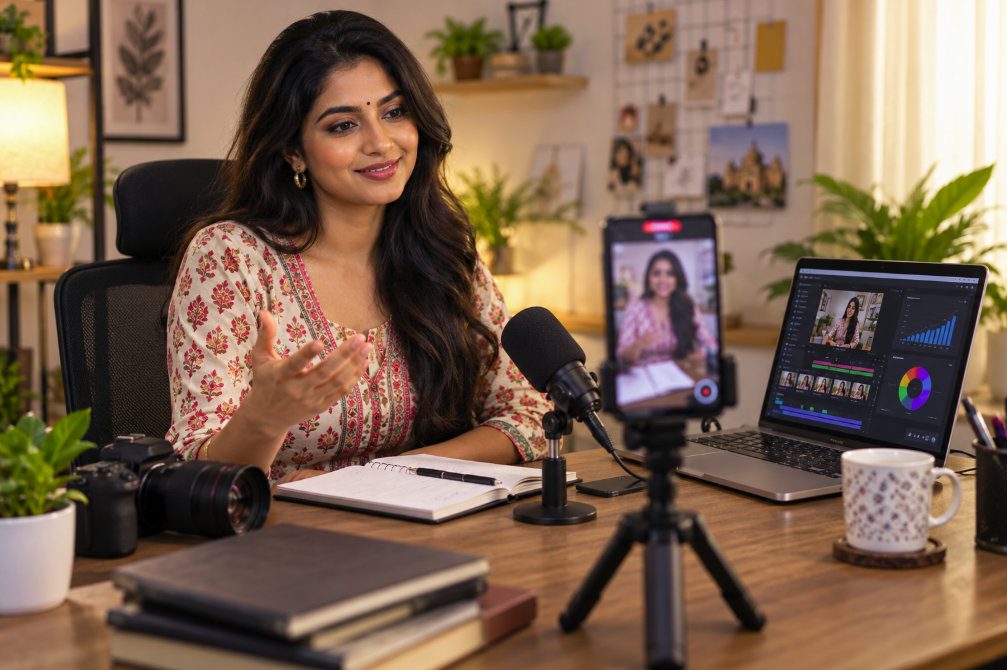
Artificial intelligence is rapidly becoming part of the operating system of India’s creator economy. For adult creators, who often face additional restrictions around advertising, discovery, payment access and platform moderation, the shift is especially significant. AI is not simply making images or writing captions; it is increasingly helping independent creators research audiences, plan publishing schedules, translate content, analyze performance and run parts of a digital business that previously required a small team.
The broader Indian creator market is already substantial. Boston Consulting Group estimated in 2025 that India had roughly 2–2.5 million monetized content creators influencing $350–400 billion in consumer spending, with creator-influenced consumption potentially exceeding $1 trillion by 2030. A 2026 study from the Srini Raju Centre for IT and the Networked Economy at the Indian School of Business and Hashfame separately estimated 4.12 million creators in 2025, using a broader creator-market methodology, and found that 66% were outside metropolitan areas. The differing figures underline how definitions vary, but both point to a large and geographically diverse ecosystem.
AI is becoming everyday creator infrastructure
The clearest change is the movement of AI from experimentation into routine production. Adobe’s 2026 Creators’ Toolkit Report said 96% of surveyed Indian creators who use or have tried creative AI believed it had accelerated growth of their business or follower base. Eighty-five percent described creative AI as integrated or essential to their workflow, while 52% said it helped them produce content faster and at higher quality than they could without it.
For independent adult creators, that efficiency can matter disproportionately. A solo operator may be simultaneously responsible for shooting and editing content, social promotion, subscriber communication, bookkeeping, search optimization and brand negotiations. Generative tools can assist with first drafts of captions, video concepts, content calendars, thumbnail ideas, editing decisions and campaign variations. The economic value is therefore less about replacing creativity than reducing the administrative and production burden surrounding it.
There is also a limit to automation. Adobe reported that 72% of creators said AI outputs typically required moderate or extensive editing before they were ready to publish, and 87% believed the final creative decision should remain with the creator. That distinction is particularly relevant in a market where personality and trust are central commercial assets. If AI makes content production easier for everyone, a recognizable human voice becomes more valuable rather than less.
Language technology can widen the addressable audience
India’s linguistic diversity makes translation and localization one of AI’s most practical creator applications. A creator who previously concentrated on English or Hindi can increasingly experiment with subtitles, translated captions, dubbing and localized promotional copy without building a separate production operation for every language.
Major platforms are pushing in the same direction. In June 2026, Meta announced Creator Assistant for Facebook, including a rollout in India, alongside expanded AI translation capabilities. The assistant is designed to interpret a creator’s performance, audience and engagement patterns and turn those signals into recommendations. YouTube has similarly been embedding AI into creator workflows through tools such as Ask Studio, which provides conversational access to channel analytics and creative insights.
For adult creators, mainstream social networks generally function less as unrestricted sales channels and more as carefully managed discovery layers because sexual-content policies can sharply limit what can be posted or promoted. AI can help adapt messaging for different channels, but it cannot override those rules. Creators still need to understand each platform’s current policies and avoid assuming that automatically generated copy, imagery or video is compliant simply because a tool produced it.
Audience intelligence is becoming more accessible
Historically, sophisticated audience segmentation and campaign analysis favored agencies and large media businesses. AI lowers that barrier. Creators can use analytics assistants to identify recurring themes in high-performing posts, compare formats, organize subscriber feedback, examine conversion patterns and generate hypotheses for future tests. The result can be a more deliberate funnel from public discovery to an owned website, mailing list or permitted subscription platform.
This matters because monetization is increasingly diversified. BCG’s analysis highlighted subscriptions, virtual gifting and live commerce among the expanding revenue models in India’s wider creator economy. Adult creators operate under a different set of platform and payment constraints, but the underlying business lesson is similar: dependence on a single source of traffic or revenue creates vulnerability. AI can make it easier to maintain several audience touchpoints by reducing the time required to prepare platform-specific material and analyze results.
AI can also improve commercial discipline. A creator can categorize campaign expenses, summarize performance reports, draft media-kit language or model different subscription and promotional scenarios. Those outputs still need human verification, particularly where taxes, contracts, payments or legal obligations are involved, but they can make basic business analysis available to creators who cannot justify a full-time manager or analyst.
More AI also means more questions about authenticity and platform rules
The same tools that reduce production costs can flood feeds with synthetic material. Adobe found that 57% of surveyed creators who felt it had become harder to stand out blamed the sheer volume of content, while 44% pointed to AI-generated content making distinctive voices harder to notice. That creates a paradox: AI helps individual creators publish more efficiently while simultaneously increasing competition for attention.
Platforms are responding with transparency measures. YouTube updated its AI labeling system in May 2026, making labels for photorealistic, meaningfully altered or generated content more prominent and introducing automatic detection signals. YouTube said an AI disclosure label by itself does not affect recommendation or monetization eligibility, although creators remain responsible for complying with the platform’s wider policies.
Creators also need to consider privacy and intellectual property. Uploading unpublished photographs, subscriber information, contracts or private business data to third-party AI services can create risks depending on the provider’s terms and data practices. Synthetic likenesses create another concern: as realistic image and video generation improves, creators have a stronger incentive to monitor impersonation and unauthorized use of their identity. YouTube, for example, has been developing likeness-detection tools intended to help creators identify AI-generated videos using their faces.
The competitive advantage is shifting from production to judgment
The most important effect of AI may be that professional-looking output is becoming cheaper. Editing, translation, ideation and basic analytics that once differentiated larger creator operations are becoming available to individuals. That does not eliminate the need for skill; it changes where the skill matters. Choosing what to publish, understanding a community, building trust, maintaining boundaries and deciding which commercial opportunities fit a creator’s identity are still fundamentally human decisions.
For Indian adult creators, this shift arrives in a market with enormous digital reach but complicated rules around content, advertising, payments and platform visibility. AI can reduce costs and widen access to capabilities that once belonged to agencies, but sustainable monetization will depend on using those capabilities without surrendering authenticity or compliance. The creators most likely to benefit will not necessarily be those who automate the most. They will be those who use automation selectively, protect their audience relationships and turn faster production into a more resilient business.