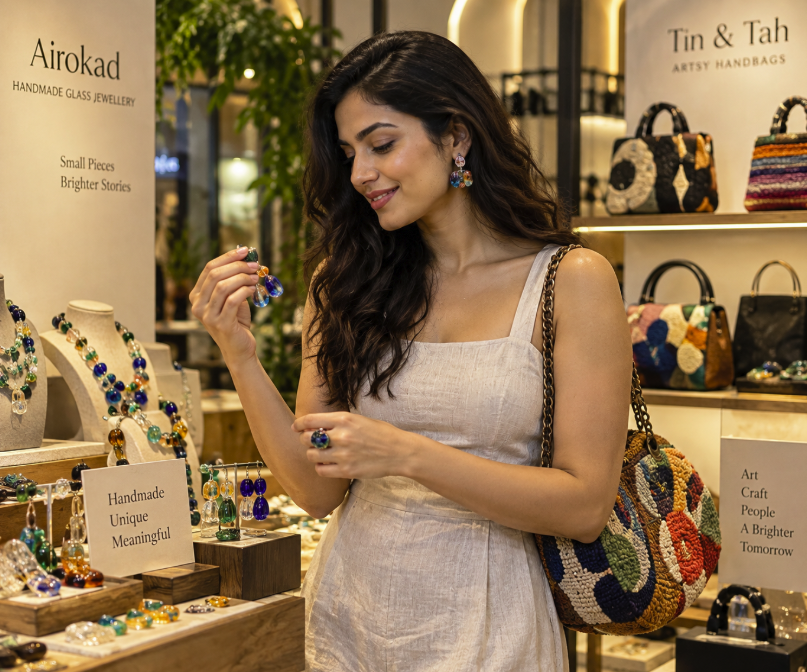
Festive dressing does not always need another heavily embellished outfit. In 2026, one of the more interesting directions in Indian accessories is the move toward pieces that look personal, handcrafted and immediately recognisable. Colourful glass jewellery and handbags inspired by art, history and illustration are offering an alternative to conventional metallic jewellery and familiar luxury-bag silhouettes.
Two homegrown labels highlighted by Grazia India on September 10 capture that mood particularly well. AIROKAD Studio works with handcrafted borosilicate glass jewellery, while Tin & Tah turns handbags into objects informed by art and cultural storytelling. They operate in different accessory categories, but both reflect the same desire: owning something distinctive enough to become the focal point of a look.
AIROKAD Studio turns glass into wearable colour
AIROKAD Studio was founded by Unnati Dakoria, according to Grazia, after she returned to India and saw an opportunity to bring more colour into a fashion-jewellery landscape she felt was dominated by metallic and neutral designs. The label works with borosilicate glass, treating it not simply as a fragile decorative material but as the basis for sculptural jewellery intended to be worn in everyday settings.
The handmade process is central to the appeal. Grazia reports that individual pieces are handcrafted, meaning small variations are part of their character rather than something to be engineered away. The designs draw on organic shapes, travel, nature and candy-like colours, producing jewellery that can feel playful without necessarily becoming costume-like.
That approach is particularly well suited to festive wardrobes. A bright glass ring, pair of earrings or necklace can provide contrast against a plain sari, a monochrome co-ord, a contemporary kurta or a minimalist dress. Instead of adding several competing accessories, the wearer can make one unusual piece the centre of attention and allow the transparency, colour and shape of the glass to do the work.
Grazia lists AIROKAD Studio’s price range at approximately INR 1,290 to INR 5,490 as of September 10, 2026. The publication specifically points to the label’s Candy Forms collection, which uses candy references and fluid silhouettes to create colourful statement pieces. Prices and availability can change, so shoppers should check the brand directly before purchasing.
Tin & Tah treats the handbag as a storytelling object
Tin & Tah approaches statement accessories from a different direction. Founded by product designer Sameeksha Jain, the label builds handbags around references that extend beyond seasonal colour trends. Grazia reports that Jain draws inspiration from sources including manuscripts, miniature paintings, mythology, architecture and engineering, translating those references into unconventional bag forms.
The result sits somewhere between a functional accessory and a small piece of wearable art. Rather than hiding the design concept behind a standard rectangular bag, Tin & Tah experiments with silhouette, illustration, texture and surface detail. Materials cited by Grazia include velvet, satin, canvas, suede and faux leather, with plant leather available on request. Antique-gold hardware contributes to the brand’s vintage-influenced aesthetic, while newer pieces incorporate embroidery and beadwork.
Grazia places the label’s reported price range between INR 5,000 and INR 22,000. Among the pieces it highlights are the Playlist Bag, which references the raagas of Hindustani music, and sculptural designs including Rani Jolie and Girl Wing’s. These are not bags designed to disappear quietly into an outfit, which is precisely why they make sense for shoppers looking for a festive accessory that can generate conversation.
Why handmade statement accessories work for festive dressing
Festive fashion often creates a styling problem: clothes, jewellery, embroidery, bags and footwear can all compete for attention at once. Statement accessories offer another strategy. A relatively restrained outfit can become occasion-ready through one object with an unusual material, shape or story. That can make getting dressed simpler while still producing a look that feels considered.
Glass jewellery works especially well when colour is the priority. Transparent and translucent surfaces interact with light differently from conventional metal pieces, and multicoloured designs can pick up smaller tones already present in a garment. An artistic handbag serves a similar function on a larger scale. Because the bag occupies more visual space, it can introduce an entire motif or colour palette without requiring additional jewellery.
The handmade character also matters in a market where shoppers can encounter very similar accessories across multiple retailers. Minor variations in handcrafted objects can make each piece feel less standardised. That does not automatically make every handmade item superior in quality, but it does give buyers another dimension to consider beyond a logo or seasonal trend.
How to style the trend without overdoing it
The easiest rule is to decide which accessory gets to lead. If the jewellery is highly colourful and sculptural, keep the handbag relatively quiet and allow the glass to sit against a simple neckline or solid-colour fabric. If the bag has an unusual silhouette, intricate embroidery or a strong illustrative theme, smaller earrings and restrained jewellery can prevent the outfit from becoming visually crowded.
For daytime festive events, handcrafted earrings can work with a handloom dress, a linen co-ord or an understated kurta-and-trouser combination. Evening dressing can accommodate larger glass forms, particularly when the outfit itself is monochrome. Artistic handbags pair naturally with saris and contemporary Indian separates, but they can be equally effective with a simple black dress or tailored suit, where the contrast makes the accessory appear even more deliberate.
Practicality still deserves attention. Glass jewellery should be stored and transported carefully even when it is made from durable borosilicate glass, while highly sculptural handbags should be checked for capacity before an event. A beautiful bag that cannot comfortably hold a phone, cards and essentials may work for a short occasion but be frustrating during a longer celebration.
Buying something unique means looking beyond appearance
Consumers attracted to handmade accessories should ask how a piece is produced, what materials are used and how it should be cared for. With jewellery, weight, closures and durability are as relevant as colour. With handbags, construction, lining, hardware, strap comfort and usable interior space can determine whether an artistic design becomes a regular part of the wardrobe or remains an occasional object.
AIROKAD Studio and Tin & Tah illustrate why the “unique, handmade, statement” formula is resonating during the 2026 festive season. One turns glass into colourful wearable sculpture; the other uses the handbag as a canvas for stories drawn from art and culture. Their strongest shared idea is not simply that accessories should attract attention. It is that the object a person carries or wears can communicate taste and individuality even when the rest of the outfit remains remarkably simple.