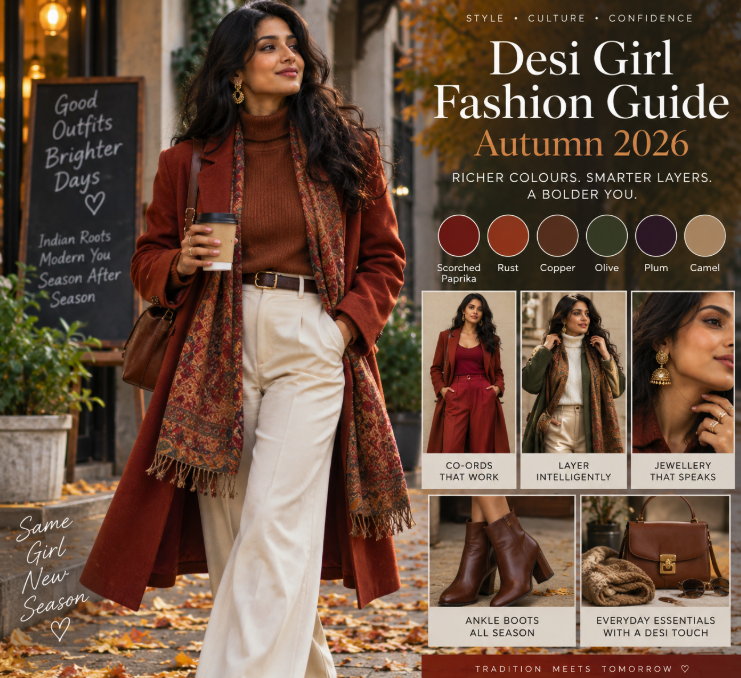
Autumn dressing in India has never been one-size-fits-all. October in Delhi, Bengaluru, Mumbai and Shimla can feel like four different seasons, while an Indian woman living in London, Toronto or Milan may already be reaching for a proper coat. That makes the best Desi autumn fashion for 2026 less about copying a runway look and more about building a wardrobe that can change temperature without losing personality.
This season's easiest formula combines rich earthy colour, intelligent layering, versatile co-ords, expressive Indian jewellery and practical ankle boots. Rust, copper and a deep scorched-paprika red create an immediate autumn mood, but they do not need to dominate every outfit. The modern Desi wardrobe works best when those warmer shades are mixed with cream, chocolate, olive, navy and touches of gold.
Start with scorched paprika, rust and copper
Warm spice colours make intuitive sense for Indian wardrobes because they already sit comfortably beside gold jewellery, handloom textiles, tan leather and many traditional prints. A rust overshirt, paprika knit or copper-toned kurta can therefore feel seasonal without looking like a costume built around autumn leaves.
Current 2026 runway reporting also shows that autumn/winter colour is broader than brown. Vogue's seasonal coverage points to navy as a major AW26 neutral, alongside continuing butter yellow and brighter shades. The useful takeaway is freedom: build a warm core palette if it suits you, then use navy, cream or even powder blue to stop the wardrobe becoming a wall of burnt orange.
The smartest layer is the one you can remove
For most Indian cities, autumn layering should be modular rather than heavy. Begin with a breathable base—a fitted cotton tee, sleeveless knit, shirt, bodysuit or straight kurta—and add one piece with structure. That could be a cropped jacket, sleeveless waistcoat, denim overshirt, lightweight blazer or long open-front layer.
A printed stole or handloom scarf is particularly effective because it changes the temperature and the visual character of an outfit without adding much bulk. In genuinely cold climates, use the same logic with warmer materials: fine merino under a blazer, then a wool coat on top. Three adaptable layers are usually more useful than one enormous sweater that only works at one temperature.
Let Indian craft become part of everyday layering
One of the strongest developments in contemporary Indian fashion is the movement of traditional textiles away from strictly ceremonial dressing. Vogue India has highlighted bandhani appearing in co-ords and everyday silhouettes, while recent styling coverage has shown handloom and embroidered pieces integrated with modern separates.
Autumn is an ideal season for this approach. Try a quilted or embroidered vest over a crisp white shirt, a bandhani jacket with jeans, a handloom overshirt over a tank, or a Banarasi-inspired coat with plain trousers. The contrast works because the craft piece carries the detail while everything around it stays clean.
Co-ords are still the shortcut to looking finished
A matching set solves one of the most common wardrobe problems: wanting to look deliberately dressed without spending twenty minutes constructing an outfit. For autumn 2026, tailored trouser-and-waistcoat sets, knit co-ords and relaxed shirt-and-pant combinations are especially useful because each piece can be separated later.
Choose a set in rust, chocolate, olive or deep burgundy and you immediately have at least three outfits: the complete co-ord, the top with denim or a skirt, and the trousers with a contrasting knit or kurta. A printed Desi co-ord can work the same way if the individual pieces are simple enough to style independently.
Mix kurtas with Western winter staples
The most interesting Desi winter wardrobes rarely divide themselves into “Indian clothes” and “Western clothes.” A straight kurta can sit under a longline blazer. Cigarette pants can work with a turtleneck and jhumkas. A cropped knit can be layered over a longer kurta, while an embroidered waistcoat can sharpen a plain shirt and wide-leg trousers.
The trick is proportion. If the kurta is long and fluid, keep the coat relatively clean and straight. If the jacket is oversized, choose a narrower bottom or a compact top underneath. When several garments are loose at once, defining the waist with a belt or using a shorter outer layer can restore shape.
Statement jewellery is no longer only for weddings
Indian jewellery is moving decisively into everyday styling. Vogue India's 2026 coverage has made the case for jhumkas with shirts and jeans, temple-inspired studs with tailored co-ords and slim haslis with crisp shirting. Separate reporting in August also noted the growing preference for versatile jewellery that can move from work to evening rather than remaining locked away for occasions.
For autumn, use one strong jewellery idea rather than wearing the entire box. Oxidised silver earrings can sharpen a black knit and denim. A sculptural gold cuff can transform a monochrome co-ord. A slim hasli over a high neckline looks unexpectedly modern, while mixed chains can animate a plain shirt. The point is contrast: precious-looking detail against clothes that feel relaxed and wearable.
Ankle boots are the bridge between seasons
Ankle boots earn their place because they work with more than jeans. A clean leather or faux-leather pair can sit under wide-leg trousers, balance a midi dress, toughen a flowing printed skirt or add structure below a kurta-and-trouser combination. Brown, oxblood and black remain the easiest colours to repeat.
Heel height should reflect real life. A block heel gives polish without turning every commute into an endurance test, while a flat Chelsea-style boot works for travel and long days. In wetter conditions, prioritise grip and water resistance over decorative suede. A fashionable shoe becomes considerably less fashionable when it cannot survive the weather.
Build an Indian girl winter wardrobe around repeatable pieces
A useful wardrobe does not need dozens of new purchases. Start with a neutral trouser or dark jean, a cream or black knit, a crisp shirt, one warm-toned co-ord, a light jacket or blazer, a scarf with Indian craft detail and a pair of ankle boots. Add a warmer coat only if your climate genuinely requires one.
From there, colour can come through accessories. A paprika bag, copper-toned earrings, an olive scarf or a burgundy lip can move a basic outfit into autumn without forcing you to buy a new seasonal wardrobe. This approach is particularly useful in Indian cities where the cold-weather window may be short.
Use texture when the temperature is still warm
When it is too hot for serious layers, texture can create the impression of autumn. Handloom cotton, lightweight corduroy, linen blends, suede-look accessories, woven bags and matte leather introduce depth without the heat of thick wool. A rust cotton shirt with ivory trousers can look more seasonally appropriate than a synthetic sweater worn purely because the calendar says November.
The same principle applies to eveningwear. Instead of piling on layers, choose a richer fabric or deeper colour and add jewellery. A dark co-ord with statement earrings often feels more autumnal than an outfit built from several uncomfortable pieces.
The 2026 Desi mood is versatility, not rules
The strongest autumn wardrobe is one that can move between office, university, coffee, travel, dinner and family plans with small adjustments. Vogue India's recent jewellery coverage reflects this broader shift toward pieces that work from desk to dinner, while Indian craft is increasingly being styled outside the festive calendar.
That is the real direction behind Desi autumn fashion 2026. Wear rust because it flatters you, not because autumn demands it. Put jhumkas with tailoring, boots under a kurta or a handloom vest over a Western shirt. Keep the layers removable and the co-ords separable. A good Indian girl winter wardrobe should feel culturally familiar without being predictable—and versatile enough that you still want to wear it when the trend cycle moves on.