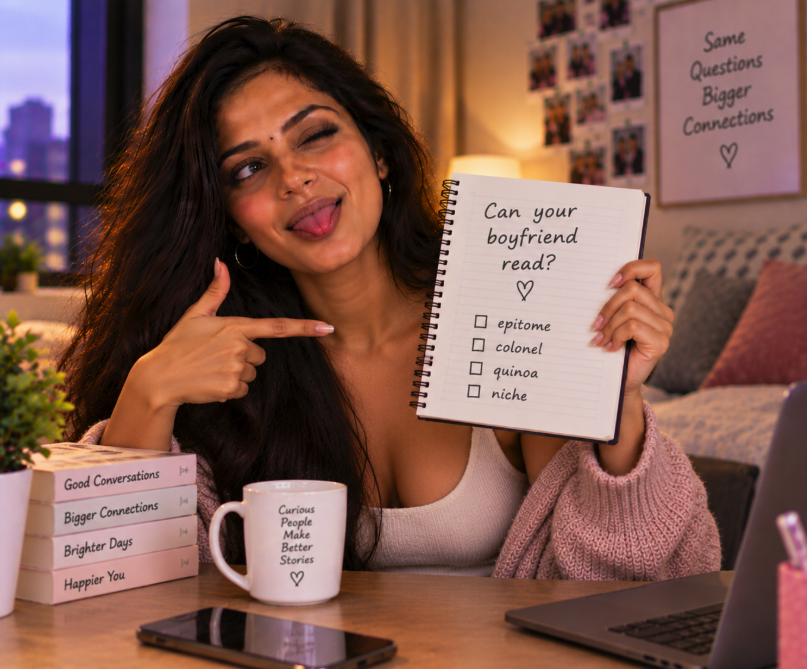
TikTok has found a new way to turn an ordinary couple interaction into a public test. The question is blunt: “Can your boyfriend read?” In videos circulating in late August and September 2026, women hand boyfriends or husbands lists of deceptively tricky English words and ask them to read the words aloud while the camera records the results.
The lists vary, but several words have become recurring characters in the trend: epitome, hyperbole, colonel, quinoa and niche. They are recognizable words whose spellings do not always make their standard pronunciations obvious. The entertainment comes from the hesitation, confident wrong guesses and reactions between partners. The controversy begins when a pronunciation challenge is presented as evidence that somebody cannot read.
Recent coverage has placed the challenge within TikTok’s long-running genre of “boyfriend tests,” following viral formats such as the orange peel theory, the bird test and “name a woman.” The structure is familiar: one partner creates a simple test, the other reacts, and millions of viewers are invited to judge what that reaction supposedly reveals about the relationship or the person being filmed.
Why these words are perfect for a TikTok challenge
English spelling is unusually good at creating traps. Colonel is the obvious example: the written form gives an inexperienced reader few clues to its familiar spoken pronunciation. Epitome can catch people who first encountered the word in print. Quinoa comes through another language and does not behave like a straightforward English phonics exercise. Even niche has pronunciation variation depending on speaker and region.
That makes the format almost engineered for short-form video. The viewer recognizes the word, anticipates the trap and waits for the boyfriend to attempt it. There is a clear setup and payoff within seconds, while the girlfriend’s reaction supplies another layer of comedy.
But recognizing what a word means and knowing how to pronounce it are not identical skills. People sometimes learn vocabulary through reading before ever hearing it spoken, producing what are informally called “book word” mistakes. The reverse can happen too: someone may know a word perfectly well in speech without having connected the sound to its unusual spelling.
A pronunciation mistake is not a literacy diagnosis
The trend becomes less harmless when isolated mistakes are treated as proof that a partner is illiterate. A short TikTok clip cannot establish somebody’s overall reading comprehension, vocabulary or ability to process written information. It certainly cannot diagnose a national literacy problem.
That has not stopped the videos from feeding a much larger online argument. Recent commentary around the trend has connected the clips to anxieties about declining reading habits, education and whether younger adults spend enough time with long-form text. The debate had already been visible around reality television, where verbal mistakes and misused expressions were being clipped and discussed as evidence of broader cultural decline.
There are legitimate questions about literacy trends in the United States, but a boyfriend stumbling over epitome is anecdotal entertainment, not a standardized assessment. The viral format rewards the funniest failures, which also means viewers are unlikely to receive a representative sample of ordinary people calmly pronouncing every word correctly.
The relationship-test formula is doing much of the work
The success of “Can your boyfriend read?” is not really about vocabulary alone. TikTok repeatedly turns relationships into small experiments because couple dynamics give viewers something to evaluate. Does he peel the orange? Does he respond enthusiastically when she mentions seeing a bird? Can he name a woman without causing trouble? Now: can he survive the pronunciation list?
These tests are highly shareable because they allow viewers to participate from outside the relationship. Comments quickly become a second performance, with strangers deciding whether the boyfriend is funny, embarrassing, intelligent, endearing or a supposed red flag.
For creators, the formula is efficient content. It needs almost no production, can be filmed at home and produces an authentic reaction that is difficult to script perfectly. Other couples can reproduce it immediately, helping the trend spread without needing to copy a dance, buy a product or learn an editing technique.
Laughing together is different from humiliating a partner
There is also a relationship boundary hidden underneath the joke. A couple who regularly tease each other may genuinely enjoy filming a pronunciation challenge. Someone who knows they are going to be posted publicly may find their own mistakes hilarious. In that context, the video can simply be another shared game.
The tone changes when one partner becomes content without meaningful agreement. Posting somebody’s embarrassing mistake to a large audience can feel very different from laughing about it privately. A trend does not remove the need to consider whether the person being filmed is comfortable with the joke and with the possibility that strangers will discuss their intelligence.
This is especially relevant when a playful challenge acquires a harsher label such as the “illiterate boyfriend test.” What begins as “try these difficult words” can quickly become “prove that my partner is stupid” once the clip enters an algorithmic audience looking for a stronger reaction.
The trend says as much about social media as it does about reading
TikTok relationship tests compress complicated qualities into visible moments. Kindness becomes whether someone peels an orange. Emotional responsiveness becomes a reaction to a bird. Literacy becomes whether a person can pronounce a curated list of irregular words on camera.
That compression is part of the entertainment, but it should not be confused with serious measurement. Relationships cannot be reliably evaluated through one viral test, and neither can reading ability. The most interesting thing about the trend may be how quickly social media converts an amusing mistake into a judgment about education, compatibility and character.
Still, the challenge has one genuinely useful side effect: people are talking about words. Viewers are comparing pronunciations, learning why English spellings can be deceptive and discovering that they may have silently mispronounced a familiar word for years. For a platform better known for relationship drama than vocabulary lessons, that is an unexpected outcome.
So, can your boyfriend read?
If the question means “Can he pronounce epitome, colonel, quinoa and niche correctly on the first attempt while being filmed?”, TikTok now has a challenge for that. If the question is genuinely about literacy, the answer requires far more information than a viral list can provide.
That distinction is what keeps the trend funny without turning every mistake into a cultural diagnosis. English is full of pronunciation traps, couples enjoy teasing each other, and social platforms love a test with an immediate result. Put all three together and “Can your boyfriend read?” becomes almost perfect TikTok material—provided everyone remembers that the punchline is a pronunciation stumble, not a complete assessment of the person holding the list.